Hello, History Minions!
There is no new blog for this week so that your peers can finish up their make-up work. Please be good Study Group members--meet, study, help, assist, and poke the reluctant learners in your group. You have three chapters due soon, so spend the extra time getting ahead!
Also, you may wish to read more about U.S. imperialism if you wish...
Thursday, February 13, 2014

Monday, February 3, 2014
Week of 2/3-2/9/2014 (3rd Week of 3rd 9 Wks)
Where the Progressives a success or a failure?
Gilded Age problems sometimes seemed intractable: corruption, party bosses, child labor, alcoholism, pollution, trusts, etc. Progressives sought to correct those problems. Although the term includes a number of interests and groups, Progressives were idealistic reforms who both felt empowered and sought to use the power of the federal government to effect change.
Starting with the Populist movement in the American Midwest, reform movements gained momentum. While the Populists could not be ignored, they failed to elect one of their own to the presidency. Check out the Spark Notes site http://www.sparknotes.com/history/american/gildedage/section6.rhtml
But what started as an agrarian movement in our heartland was transformed into a broader Progressive movement in our urban centers. Presidents Roosevelt, Taft, and Wilson all made Progressive reforms that transformed the United States and changed the course of our history. ( http://www.sparknotes.com/history/american/gildedage/section9.rhtml)
But were the Progressives truly effective? Where they successful? That's still a topic of debate.
Decided for yourself whether the Progressives were a success or failure and give an ECONOMIC, SOCIAL, and POLITICAL FACT to justify your reasoning.
Gilded Age problems sometimes seemed intractable: corruption, party bosses, child labor, alcoholism, pollution, trusts, etc. Progressives sought to correct those problems. Although the term includes a number of interests and groups, Progressives were idealistic reforms who both felt empowered and sought to use the power of the federal government to effect change.
Starting with the Populist movement in the American Midwest, reform movements gained momentum. While the Populists could not be ignored, they failed to elect one of their own to the presidency. Check out the Spark Notes site http://www.sparknotes.com/history/american/gildedage/section6.rhtml
But what started as an agrarian movement in our heartland was transformed into a broader Progressive movement in our urban centers. Presidents Roosevelt, Taft, and Wilson all made Progressive reforms that transformed the United States and changed the course of our history. ( http://www.sparknotes.com/history/american/gildedage/section9.rhtml)
But were the Progressives truly effective? Where they successful? That's still a topic of debate.
Decided for yourself whether the Progressives were a success or failure and give an ECONOMIC, SOCIAL, and POLITICAL FACT to justify your reasoning.
Tuesday, January 21, 2014
Week of 1/20-2/1/2014 (1st-2nd of 3rd 9 Weeks) EXTENDED!
History Minions,
Don't forget that you will need to two blog posts--one where you type a substantial response to my question and one where you reply (respectfully) to a classmate. To receive credit you need to contribute factual detail, and you cannot repeat what has already been said.
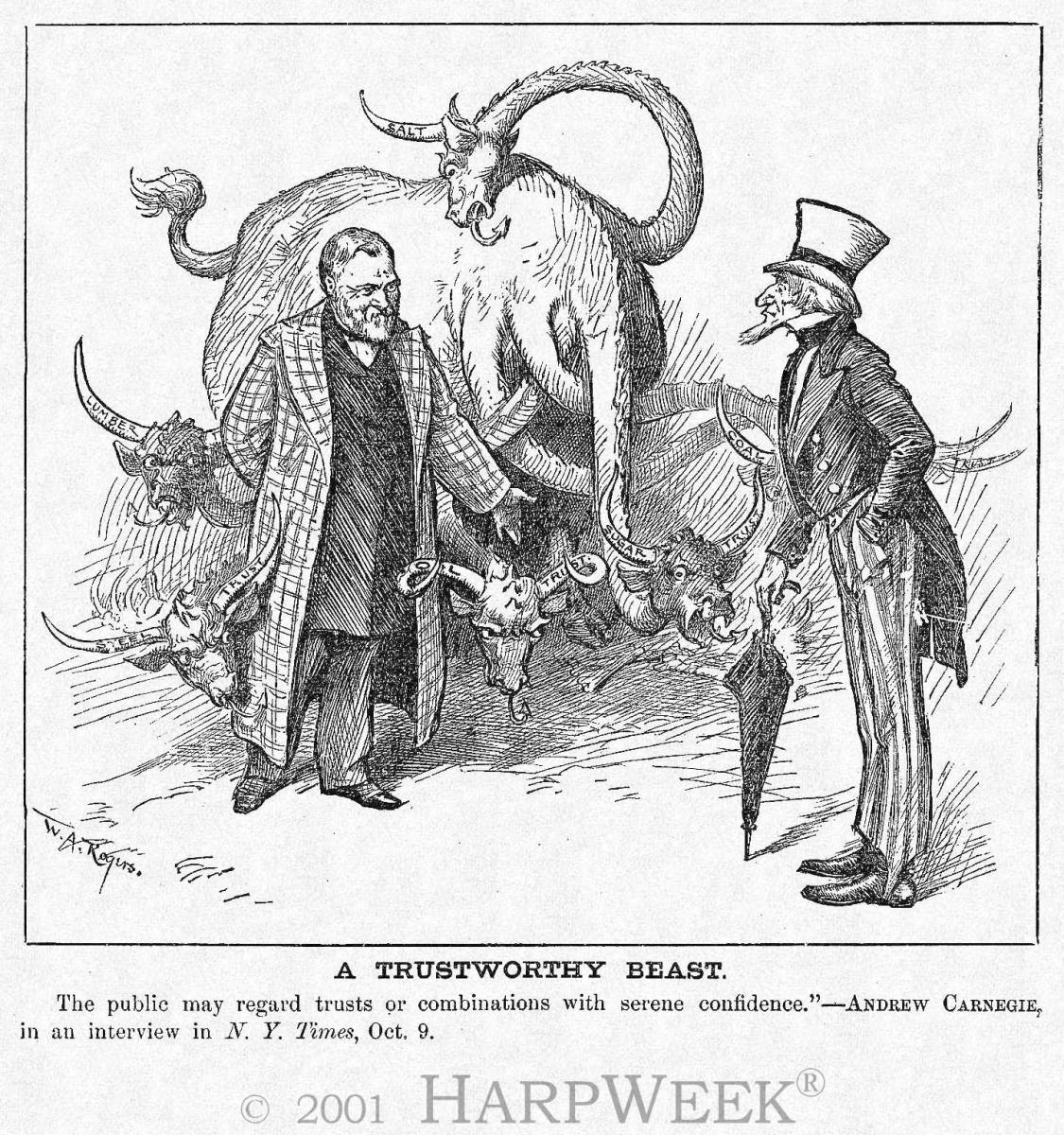
In the post–Civil War United States, corporations grew significantly in number, size, and influence.
Analyze the impact of big business on the economy and politics and the responses of Americans to these
changes. (You should only discuss the period 1870 to 1900. )

Need help getting started? Think of a big business. Explain what it was and what it did. Did it create a trust? Did it follow fair business standards, or did it follow a laissez faire philosophy? What effect did that business have on the economy? On society? On politics? How did people respond?
Don't forget that you will need to two blog posts--one where you type a substantial response to my question and one where you reply (respectfully) to a classmate. To receive credit you need to contribute factual detail, and you cannot repeat what has already been said.
In the post–Civil War United States, corporations grew significantly in number, size, and influence.
Analyze the impact of big business on the economy and politics and the responses of Americans to these
changes. (You should only discuss the period 1870 to 1900. )
Need help getting started? Think of a big business. Explain what it was and what it did. Did it create a trust? Did it follow fair business standards, or did it follow a laissez faire philosophy? What effect did that business have on the economy? On society? On politics? How did people respond?
Good luck and happy blogging!

2/03/2014 The Gilded Age... Today's Class Warm-up
History Minions--
After careful analysis of your Gilded Age documents, I want you to consider what the key problems of the era really were. Cities had more to worry about than garbage collection and unsafe drinking water, although these problems were symptomatic of larger issues.


Check out this link to SparkNotes:
http://www.sparknotes.com/history/american/gildedage/context.html
What were the worst economic, social, and political issues facing our Gilded Age cities? Select one (or more) for each category and explain WHY you chose that problem.
After careful analysis of your Gilded Age documents, I want you to consider what the key problems of the era really were. Cities had more to worry about than garbage collection and unsafe drinking water, although these problems were symptomatic of larger issues.
Check out this link to SparkNotes:
http://www.sparknotes.com/history/american/gildedage/context.html
What were the worst economic, social, and political issues facing our Gilded Age cities? Select one (or more) for each category and explain WHY you chose that problem.
Tuesday, January 7, 2014
Semester Exam Review, Week of 1/6-1/17/2014
Greetings History Minions! We will start out with some Semester One review!
Your Semester Exam will consist of two FRQ's and a multiple choice section, so this is a good way to get familiar with the class blog.
Each person should add notes to TWO topics until all the topics have been THOROUGHLY answered and explained. Be sure to sign your name after your answer. :)
Happy Blogging!
........................
1) “The God that holds you over the pit of hell, much as one holds a spider, or some loathsome insect over the fire, abhors you, and is dreadfully provoked; his wrath towards you burns like fire; he looks upon you as worthy of nothing else, but to be cast into the fire; . . . and yet it is nothing but his hand that holds you from falling into the fire every moment.”
Explain this quote. Where does it come from, and what is typical of the era it comes from? What ideas are typical of this kind of writing?
Your Semester Exam will consist of two FRQ's and a multiple choice section, so this is a good way to get familiar with the class blog.
Each person should add notes to TWO topics until all the topics have been THOROUGHLY answered and explained. Be sure to sign your name after your answer. :)
Happy Blogging!
........................
1) “The God that holds you over the pit of hell, much as one holds a spider, or some loathsome insect over the fire, abhors you, and is dreadfully provoked; his wrath towards you burns like fire; he looks upon you as worthy of nothing else, but to be cast into the fire; . . . and yet it is nothing but his hand that holds you from falling into the fire every moment.”
Explain this quote. Where does it come from, and what is typical of the era it comes from? What ideas are typical of this kind of writing?
2) The term triangular trade describes…Why is it
important?
3) The immediate issue in dispute in
Bacon’s Rebellion was…
4) Why did the Puritans establish the Massachusetts Bay Colony? What were their goals?
5) In the
seventeenth century, the Chesapeake Bay settlement expanded its territorial
holding more quickly than did the Massachusetts Bay settlement. Why?
6) Who
was Roger Williams and what did he believe?
7) What
was the colonial era like? What are its
characteristics? What was it like for colonial
families in mid-eighteenth century America?
8) What
was the purpose of slave codes?
9) What
happened with the John Peter Zenger Trial in 1735, and why is it important?
10) What
was the headright system in the Virginia colony, and why was it use? What was the impact/effect of this system?
11) What
is mercantilism and how did it affect the relationship the colonies had with
Great Britain?
12) What was the
Battle of Saratoga, and why was it significant?
13) What were Townshend Acts, and how
did American colonies react? What did they believe about this form of taxation?
14) Why were the Battles
of Lexington and Concord were significant?
15) How did the French and Indian War change
American attitudes toward Great Britain? What were the effects of the war?
16) What were the Sugar Act and the
Townshend Act? How were they different
from the previously passed Navigation Acts?
17) What was the Declaration of
Independence and what did it do?
18) What is the significance of the Battle of Yorktown? Why/how did we win the American Revolution?
19) Explain this quote: “All men are created equal… [and] they are
endowed by their Creator with certain unalienable rights… among these are life,
liberty, and the pursuit of happiness; that to secure these, governments are
instituted among men, deriving their just consent of the governed; that
whenever any form of government become destructive of these ends, it is the
right of the people to alter or abolish it…”
What is the connection to the Enlightenment and to John Locke?
20) What was the Proclamation Line of 1763?
What was it supposed to do?
21) What is meant by “virtual
representation” as it was argued during the eighteenth century?
22) What were the Committees of
Correspondence? What did they do?
23) What did the 1783 Treaty of Paris do?
24) How did the Boston Massacre serve to
rally American opposition to British policy?
25) Why is the Stamp Act Congress of 1765
was historically significant?
26) How could the religious revival known
as the Great Awakening also have political ramifications on
colonial society?
27) Why did the Sugar Act of 1764
represent a major shift in British policy toward the colonies? What was the big deal?
28) Do you know strengths and weaknesses
of the Americans and British during the Revolutionary War?
29) Who were the Loyalists, and what did
they believe? Who were the patriots, and
what did they believe?
30) What were the Articles of
Confederation? What were the strengths
and weaknesses of this government?
31) What was the significance of Shays’ Rebellion? What happened as a result?
32) What is the significance of Marbury v. Madison?
33) What is the Louisiana Purchase and
why was an important factor in the development of U.S. trade?
34) What was Henry Clay’s American System? What was it supposed to do, and what disputes
resulted?
35) What was the Judiciary Act of 1789?
36) Why was the War of 1812 is considered a turning point in
U.S. history?
37) What was the Missouri Compromise, and what did it do?
38) What is the Bill of Rights? What does it do? How is it connected to the debate over
ratification of the U.S. Constitution?
39) What was the 1828 “Tariff of Abominations”? Why did the South strongly oppose it? What did the South really fear the tariff
would do to states power and slavery?
40) What was the Indian Removal Act of
1830? Why did President Andrew Jackson
support it?
41) What were the causes and effects of
the Texas Revolution? How did it push us
closer to the Civil War?
42) What was the doctrine of
nullification? What region of the U.S.
supported the idea and why?
43) What was the Monroe Doctrine? Why was it issued?
44) Why was the Election of 1800 considered
a “revolution”?
45) What was the XYZ Affair? Why was it
important?
46) What was the
Compromise of 1877? What were its results?
47) Why
did Anti-Federalists oppose ratification of the Constitution? What did they
fear?
48) Who was John Marshall and why
is he so significant in U.S. history?
How did his work impact the federal government?
49) What was the Whiskey Rebellion,
and how did President Washington respond?
What message did this send the country?
50) What was the Dred Scott decision? What did the
Supreme Court rule, and how was this a step toward the Civil War?
51) What was the significance of Harriet
Beecher Stowe’s Uncle Tom’s Cabin?
52) What is meant by “Manifest
Destiny”?
53) What did Southerners mean by “popular sovereignty”? What did this idea allow states to do?
54) What was the Compromise of 1850? Can you list all the
parts? What aspect was most controversial?
55) What was the Kansas-Nebraska
Act of 1854? Why did it further inflame political passions?
56) What was the Wilmot Proviso?
What did it support?
57) What were the effects of the
Mexican War? How did it help push us
closer to the Civil War?
58) What is Transcendentalism? What ideas did writers such as Emerson,
Thoreau, and Fuller stress?
59) Who was Dorothea Dix? What is her significance in U.S. history?
60) Who was Horace Mann? What was
his significance in U.S. history?
61) What do you know about the Lowell
System? What made it acceptable for women to work there? Could a woman become financially independent
working at a factory??
62) What was the Church of Jesus
Christ of Latter Day Saints (Mormons)? How did they contribute to U.S.
history? How did they help develop the
West?
63) What was meant by the Cult of
True Womanhood? Describe middle class views about women during the mid-19th
century.
64) Why is Eli Whitney (and his 2
inventions) so significant in U.S. history?
What happened as a result?
65) Explain the slogan “Fifty-four
forty or fight”. What was the issue? The
effect?
66) Who was William Lloyd Garrison,
and why was his publication The Liberator,
significant?
67) What changes occurred as a result
of westward migration c 1848-1849?
68) What was Lincoln’s Ten Percent Plan?
What was it supposed to do?
69) What was Andrew Johnson’s plan for
Reconstruction? Could you list its parts?
70) What was the “Freeport Doctrine”? What Stephen A. Douglas
state he believed?
71) What was the Wade-Davis Bill? What did it do?
72) How or why did Lincoln
win the 1860 presidential election?
73) What was the sharecropping
system? What effects did it have in the South following the Reconstruction?
74) What battle is considered the
“turning point” of the Civil War and the last chance at Confederate military
victory?
75) Why was President Andrew
Johnson impeached? What did it have to do with the Tenure of Office Act?
76) Why did
President Lincoln issue the Emancipation Proclamation—what was his
purpose? Did it really “set all the
slaves free”?
77) When the Civil War started, what
did President Abraham Lincoln say was the purpose of the war?
78) Why was the election of 1860 a “big
deal” to Southern slave owners? What did
they fear, and why?
79) What were the results of the
Compromise of 1877? What did it end?
What were the effects?
Saturday, May 18, 2013
Week of 5/20-5/26 (LAST BLOG OF THE YEAR)
Well, my History Minions, the party's almost over. Que lastima!
My class may have been difficult for some of you. Some students said they had never written a thesis statement prior to AP US History. Nine students told me they never had to study for class before. Some of you said you had never before worked with a study group. Some of you said you were learning how to organize yourselves, your materials, and your time. Several students admitted they had never before read a textbook!
I hope you have gained positive experiences from my class. I know what my goals for you were, and what I hoped you would learn! So let's take a few minutes to reflect. Pick one or more of these and write:
As always, happy blogging to you! I wish you all the very best next year and beyond!
My class may have been difficult for some of you. Some students said they had never written a thesis statement prior to AP US History. Nine students told me they never had to study for class before. Some of you said you had never before worked with a study group. Some of you said you were learning how to organize yourselves, your materials, and your time. Several students admitted they had never before read a textbook!
I hope you have gained positive experiences from my class. I know what my goals for you were, and what I hoped you would learn! So let's take a few minutes to reflect. Pick one or more of these and write:
- What have you gained from the experience of this AP class?
- Was the AP test what you expected?
- If you could take the class over, what would you do differently the second time?
- What did you most enjoy?
- Do you think any differently about US history now?
- Are there US history topics you wish you had more time to pursue now?
- How did you feel about having to complete blog posts?
- What have you learned about yourself?
- Have you gained any new skills or insights?
- What advice would you offer new students?
- Will this class help you in the future? If so, how?
As always, happy blogging to you! I wish you all the very best next year and beyond!
Monday, May 6, 2013
Week of 5/06-5/19/2013 (6th Week of 4th 9 Wks)
Greetings History Minions!
I really liked some of the information posted last time. You are all busy studying for AP exams, so this post is good for TWO weeks :) This ought to give you a little help with Civil Rights topics too!
Pick Option 1 OR Option 2:
Option 1) How did the African American Civil Rights movement of the 1950s and 1960s address the failures of the Reconstruction?
Option 2) "Between 1960 and 1975, there was great progress in the struggle for political and social equality." Assess the validity of this statement with respect to ONE of the following groups during that period.
African Americans
Asian Americans
Latinos
Native Americans
Women
I really liked some of the information posted last time. You are all busy studying for AP exams, so this post is good for TWO weeks :) This ought to give you a little help with Civil Rights topics too!
Pick Option 1 OR Option 2:
Option 1) How did the African American Civil Rights movement of the 1950s and 1960s address the failures of the Reconstruction?
Option 2) "Between 1960 and 1975, there was great progress in the struggle for political and social equality." Assess the validity of this statement with respect to ONE of the following groups during that period.
African Americans
Asian Americans
Latinos
Native Americans
Women
Subscribe to:
Posts (Atom)